
STUDIO GUIDE
Photography contract template: what to include, with a starting template
A portrait photography contract should name both parties and the session, then set out the booking fee and payments, rescheduling and cancellation, image delivery, copyright and licence, portfolio and social media permission, privacy, safety, and a limit of liability, then be signed by both of you. Below are the clauses explained, a template to start from, and extras for newborn, pet, kids and boudoir sessions.
By the Allio team. Updated 22 October 2026.

Not legal advice. This guide and template are a starting point, not legal advice. Contract, consumer and copyright law differ between countries and states. Have your contract checked by a lawyer where you work before you use it.
Why a contract matters for a portrait studio
Most disputes in portrait photography aren’t about the photos. They’re about money and expectations: a cancelled session, a booking fee, how many images are included, when the gallery arrives, or a photo appearing on Instagram without permission. A contract settles those questions before the session, in writing, while everyone is happy.
What to include in a photography contract
- The parties. Your business’s legal name and the client’s name and contact details. For children, a parent or guardian signs.
- The session. Type, date, time, location, length and exactly what’s included.
- Booking fee and payments. How much holds the date, whether it comes off the final order, and when the balance is due.
- Rescheduling. How many times and with how much notice, plus what happens with illness, weather or a baby arriving early.
- Cancellation and refunds. What happens to payments if either side cancels. Consumer law may limit what you can keep, so this is a clause to have checked.
- Image delivery. How images are delivered, when, for how long the gallery stays online, and that unedited files aren’t included.
- Copyright and licence. Who owns copyright, and what the client may do with the images.
- Portfolio and social media permission. A separate yes or no, never assumed.
- Privacy. How you store and use the client’s details and images.
- Safety and conduct. Your right to pause a session, and niche specifics.
- Limit of liability. What you owe if something outside your control means you can’t deliver.
- Governing law and signatures. Which state or country’s law applies, then both signatures and dates.
Copyright: don’t rely on the default
Who owns the copyright in a portrait by default depends on where you are, which is why the template states it in writing.
United States. Copyright generally belongs to the photographer as the author, unless it’s a work made for hire or is transferred in writing. Clients usually receive a licence to use the images, set out in the contract.
Australia. For a photograph commissioned and paid for a private or domestic purpose, such as a family or children’s portrait, the client is the first owner of copyright unless you agree otherwise (Copyright Act 1968, section 35). If you want to own copyright, the agreement has to say so, and the client has to agree to it.
Other countries have their own rules. Ask your lawyer which applies to you.
A photography contract template to start from
Template only. Not legal advice. Fill in the [brackets], delete what doesn’t apply, and have the finished agreement checked by a lawyer where you work before you send it to a client.
Portrait Session Agreement (template)
- Parties. This agreement is between [Studio legal name], [address] (the Studio) and [Client name], [address, email, phone] (the Client). If the session includes children, the Client confirms they are the parent or legal guardian.
- The session. Session type: [type]. Date and time: [date, time]. Location: [location]. Length: about [length]. Included: [what is included, for example number of edited images or a viewing appointment].
- Booking fee and payments. A booking fee of [amount] is due to hold the date and [is / is not] deducted from the final order. The balance of [amount or “the order total”] is due [when]. Payment plans: [terms, if any].
- Rescheduling. The Client may reschedule [number] time(s) with at least [notice period] notice. The Studio may reschedule for illness, unsafe weather or equipment failure, and will offer the next available date.
- Cancellation and refunds. If the Client cancels with [notice period] notice or more: [what happens to the booking fee]. With less notice: [what happens]. If the Studio cancels and cannot offer a new date, the Client receives a full refund of payments made.
- Late arrival. If the Client arrives late, the session may be shortened to keep later bookings on time.
- Images and delivery. The Studio chooses and edits the images. Delivery: [gallery, viewing appointment or prints] within [timeframe]. Unedited files are not supplied. The gallery is available for [period]; the Client should keep their own copies.
- Copyright and licence. The parties agree that the Studio owns copyright in all images from the session. [Australia: for a family, kids, newborn, pet or boudoir portrait the client owns copyright unless this agreement says otherwise, so sign this before the session.] The Studio grants the Client a personal, non-commercial licence to print and share the images they receive, with credit to the Studio where practical. Commercial use needs written permission.
- Portfolio and social media use. The Studio will only use images publicly (website, social media, advertising, competitions) if the Client ticks yes: [ ] Yes [ ] No [ ] Yes, but not images of [details]. The Client can withdraw permission for future use at any time by writing to the Studio.
- Privacy. The Studio keeps the Client’s details and images secure, uses them only to provide the session and products, and handles them in line with its privacy policy at [link].
- Safety and conduct. The Studio may pause or end a session if anyone’s safety is at risk. [Newborn: babies are posed for safety first, with a parent or assistant close by, and some images are composites.] [Pet: the Client is responsible for their pet’s behaviour and any damage it causes.]
- Limit of liability. If the Studio cannot deliver the images because of loss, damage or circumstances outside its control, its liability is limited to [for example, a refund of payments made or a reshoot], to the extent the law allows.
- The whole agreement. This agreement, the booking details and the invoice are the whole agreement. Changes must be in writing. This agreement is governed by the law of [state or territory, country].
- Signatures. Client signature, name and date. Studio signature, name and date.
Extra clauses by type of session
Newborn. Safety comes first and you may pause for feeds and settling. Say that some poses are composites made from more than one image with a parent’s hand supporting the baby, and how you’ll move the session if baby arrives early or late.
Kids. A parent or guardian signs and stays for the session. Ask separately whether images of the child may be shared, and respect a no.
Pet. The owner is responsible for the pet’s behaviour, safety and any damage. Note leash rules for public locations, and that sessions run at the animal’s pace.
Boudoir. Add a privacy clause: who sees the images, how they’re stored and delivered, and that nothing is shared or entered into competitions without specific written permission for each image. Confirm the client is an adult, and offer a no-sharing option by default.
Contracts versus model releases
The session contract covers the job. A model release covers using someone’s image to promote your business, and for advertising some places expect a separate, more detailed release. A clear portfolio permission clause is a good start. Ask your lawyer whether you also need a separate release for advertising, and ask about one for any child whose images you want to use in advertising.
Send it, sign it, keep it with the client
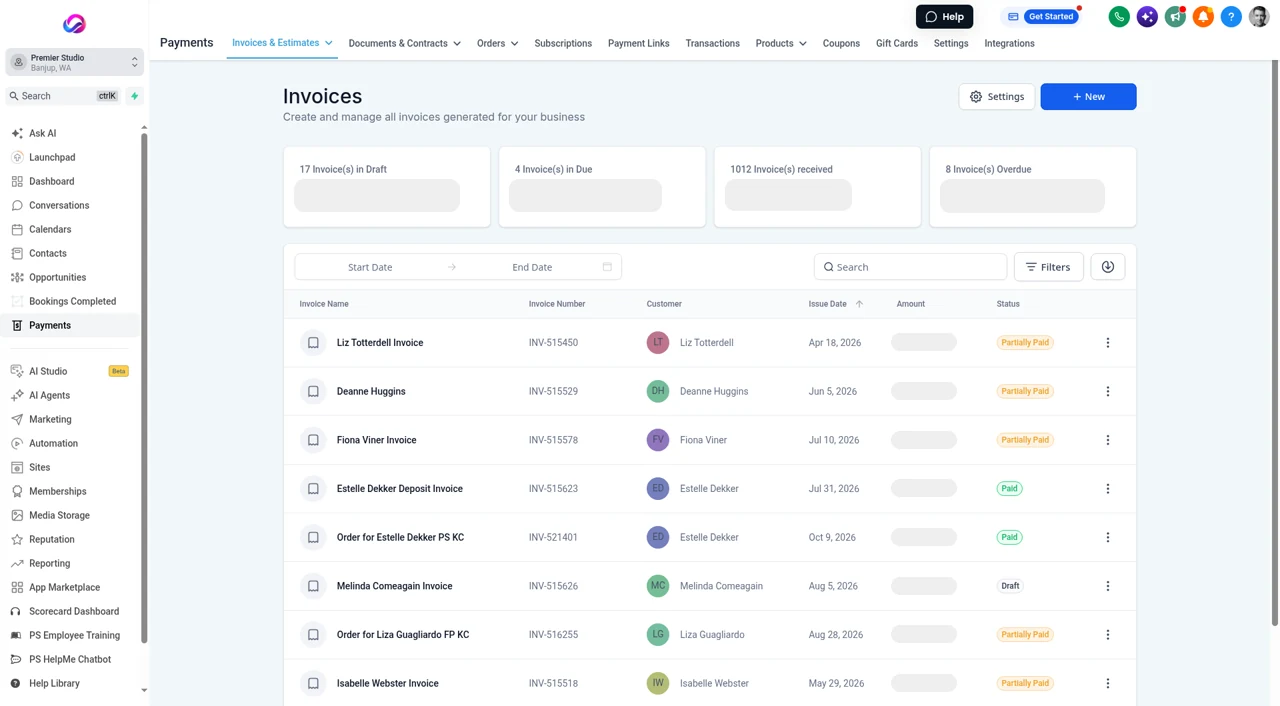
Send the contract when the client books, before you take the session. Electronic signatures are generally recognised in the US and Australia, with some exceptions, so a signed digital agreement is normal practice. Keep the signed copy where you’ll find it again: on the client’s record, next to their invoice and messages.
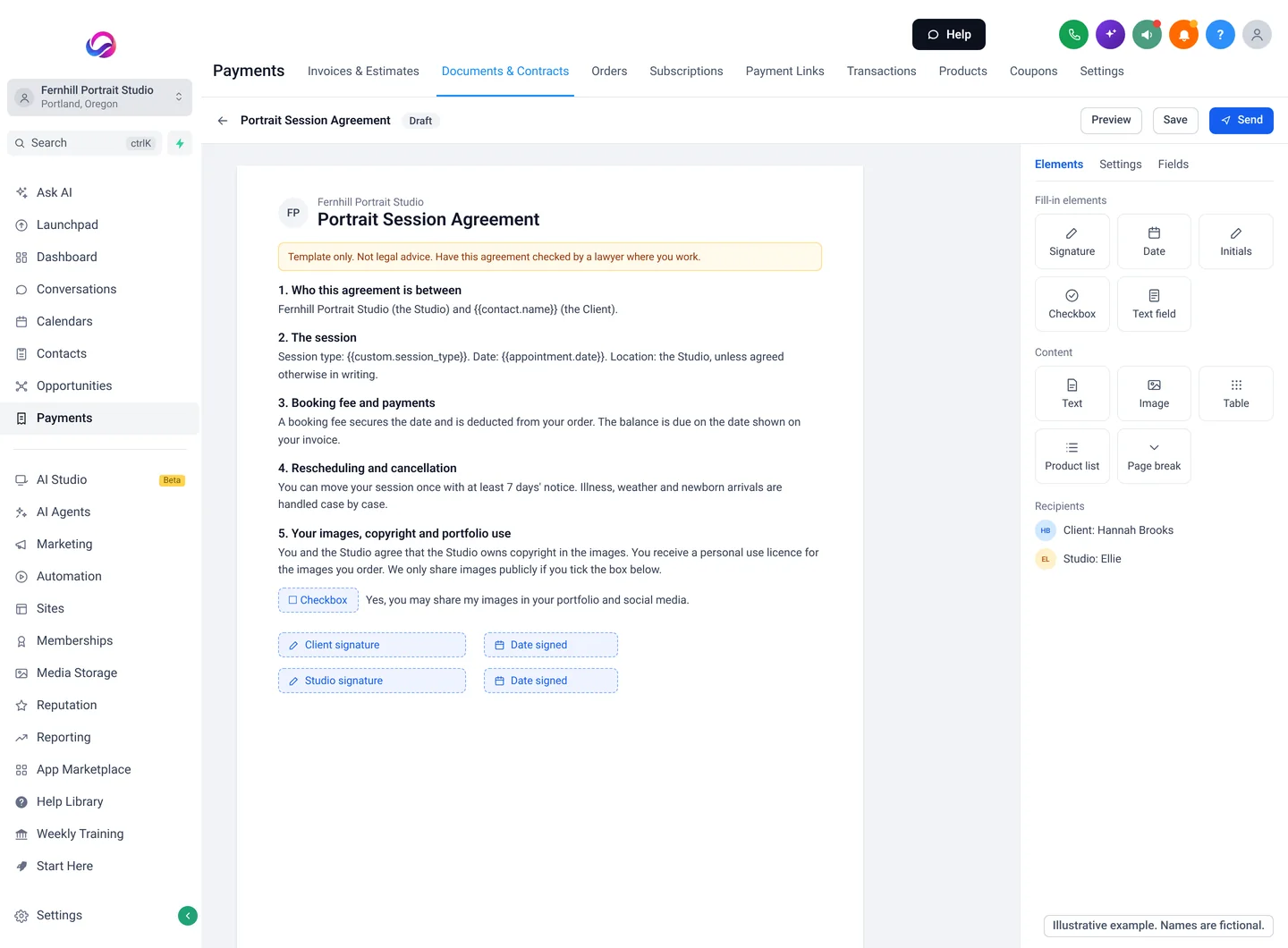
Where Allio fits: In Allio you can send an invoice, take a deposit or send a contract for signature straight from a text or email thread, and the signed document stays on the client’s record. See features and the unified inbox.
What to ask your lawyer to check
- Whether your booking fee and cancellation terms are allowed under consumer law where you work
- Copyright ownership and the licence wording
- The limit of liability clause, and what the law won’t let you exclude
- Privacy obligations for storing client details and images, especially of children and boudoir clients
- Electronic signature requirements
- Which law governs the agreement if clients travel to you from another state
Photography contract questions
Is a photography contract template legally binding?
A signed agreement can be binding, but a template is only a starting point. Whether each clause is enforceable depends on the law where you work. Have yours checked by a local lawyer before you use it.
Who owns the copyright in portrait photos?
It depends on the country. In the US, the photographer generally owns copyright unless it’s a work made for hire or transferred in writing. In Australia, the client generally owns copyright in a commissioned private or domestic portrait unless you agree otherwise. State it clearly in your contract.
Can I keep the booking fee if a client cancels?
Your contract can say what happens to the booking fee, but consumer law may limit what you can keep, and it differs by place. This is one of the clauses to have checked.
Can clients sign a photography contract online?
Electronic signatures are generally recognised in the US and Australia, with some exceptions. Ask your lawyer if you’re unsure for your situation.
Do I need a separate model release?
A portfolio permission clause in your contract covers many uses. For advertising, especially with children, you may need a separate, more detailed release. Ask your lawyer.
Do I need a different contract for boudoir sessions?
Use the same structure with a stronger privacy clause: who sees the images, how they’re stored and delivered, and no sharing without written permission for each image.
Sources
- US Copyright Office, Copyright Basics (Circular 1): copyright.gov/circs/circ01.pdf
- US Copyright Office, Works Made for Hire (Circular 9): copyright.gov/circs/circ09.pdf
- Copyright Act 1968 (Australia), section 35, ownership of copyright: austlii.edu.au/au/legis/cth/consol_act/ca1968133/s35.html
- Law Handbook (South Australia), who owns copyright: lawhandbook.sa.gov.au/ch11s06.php
- US Electronic Signatures in Global and National Commerce Act, 15 USC 7001: law.cornell.edu/uscode/text/15/7001
- Electronic Transactions Act 1999 (Australia): legislation.gov.au/C2004A00553/latest/text
Checked 22 October 2026.
Send the contract from the same thread as the booking.
The trial is seven days, card required, and you can be in within minutes.
Want the story first? Read who built Allio and why, or see what a call about Allio covers.
$297 per month. Card required. AI and phone usage is billed at cost, on top of the $297.