
STUDIO GUIDE
Photography pricing guide: how to price portrait sessions and products
To price portrait photography, start from your own numbers, not someone else’s price list. Add up a year of business costs and the income you need, estimate how many sessions you can really do, and divide to find what each session must bring in on average. Then choose a sales model (images included, or a session fee plus products), price each product from its cost and your time, and set it out in a short, clear pricing guide for clients. Every number on this page is a labelled worked example, not a recommended price.
By the Allio team. Updated 22 October 2026.

Step 1: your cost of doing business
List a year of costs: equipment (spread over its useful life), software, insurance, studio rent, website, advertising, accounting, education, car and travel, and product costs. Then add what you need to pay yourself, and an amount for tax.
Worked example. The numbers are made up to show the method, not a suggested price. Use your own.
Yearly business costs: $18,000. Pay for yourself: $50,000. Tax set aside: $12,000. Total the business must earn: $80,000.
Step 2: how many sessions you can really do
Count the whole job, not just the shoot: replying to the enquiry, the consultation, travel, the session, culling and editing, the viewing or gallery, ordering and delivery. Then work out how many sessions fit in a year, allowing for quiet months, holidays and admin days.
Worked example. The numbers are made up to show the method, not a suggested price. Use your own.
Each session takes about 8 hours from enquiry to delivery. With 25 hours a week for client work, over 44 working weeks, that’s about 1,100 hours, or about 137 sessions. Call it 120 to allow for slow weeks.
Step 3: what each session must bring in
Divide the total the business must earn by the number of sessions. That’s your average sale per client: what each family, on average, needs to spend with you, including any products.
Worked example. The numbers are made up to show the method, not a suggested price. Use your own.
$80,000 divided by 120 sessions is about $667 per client, on average.
If that number looks high for your area, you have three levers: lower your costs, take more sessions, or raise the average sale with products. Lowering your price usually isn’t one of them.
Step 4: choose your sales model
Images included. One price covers the session and a set of digital images. Simple to sell and quick to deliver, but every client pays roughly the same, so the price has to carry your whole average.
Session fee plus products. A smaller session fee, then clients choose prints, albums, wall art or digital images, often at a viewing appointment. More time per client, and a wider range of sales.
Many studios mix the two, for example images included for mini sessions and products for full sessions. Whichever you choose, be clear about it before the session.
If your average looks too high
Check the inputs before you panic. Are the costs real, or a wish list? Could some work be batched, such as editing on fixed days, to fit more sessions? Could a product clients already ask for, such as an album, lift the average sale? Changing one input at a time shows which lever matters most for your studio.
Step 5: price products from cost and time
For each product, add the lab or supplier cost, packaging and shipping, and the time it takes you to design and order it, then a margin. Check the price still works if a client buys only that product.
Worked example. The numbers are made up to show the method, not a suggested price. Use your own.
A framed print costs $90 from the lab, with $15 of packaging and delivery and 30 minutes of design and ordering valued at $30. Cost: $135. Priced at $400, it covers its cost and contributes to your average sale.
Step 6: build packages
Packages make choosing easier. Three is usually enough: a smaller option, the one most clients choose, and a larger one. Build the middle package around the average sale you worked out, and make sure each package is profitable on its own.
Worked example. The numbers are made up to show the method, not a suggested price. Use your own.
Package A: 10 digital images. Package B: 20 digital images and one framed print. Package C: all images, an album and a wall piece. Each is priced so it covers its own costs, with Package B close to the $667 average.
Step 7: write a client pricing guide
A pricing guide is the short document or page you send to enquiries. Keep it to one or two pages:
- What each session includes and how long it takes
- The session fee and the booking fee
- Your packages, or a starting point for products
- How the viewing or gallery works
- How to book, and your rescheduling policy
Some studios publish full prices, some publish starting prices and send the full guide on request. Either works if it’s honest and clear.
Step 8: check your numbers every few months
Compare your real average sale and number of sessions with your plan. Raise prices when you’re fully booked or your costs rise, and tell existing clients in advance. Keep price lists in one place, so your team and your AI quote the same numbers.
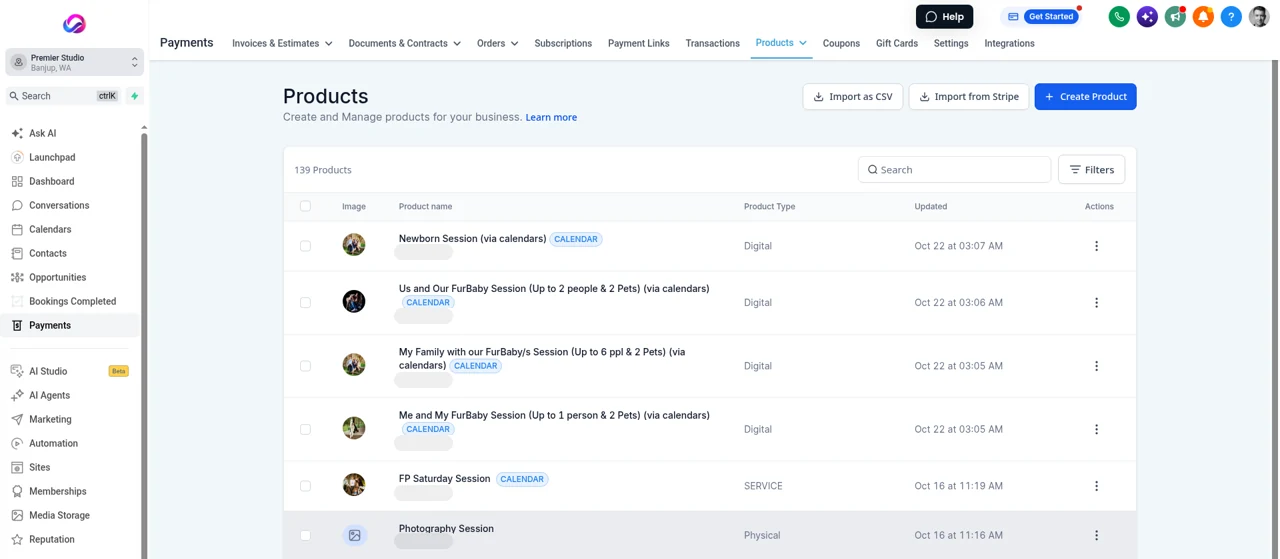
Where Allio fits: In Allio, sessions and products sit in one product list linked to your booking calendars, invoices show what each client paid, and the AI knowledge base can hold your price list as a table, so the AI has the right prices to quote. See how to train the AI on your studio.
Common pricing mistakes
- Copying a competitor’s prices. Their costs, hours and sales model aren’t yours.
- Forgetting the hidden hours. Editing, emails and ordering often take longer than the shoot.
- Forgetting tax and your own pay. If the price only covers costs, the business is paying you nothing.
- Too many options. A long menu slows clients down. Three packages and a short product list are easier to choose from.
- Discounting to fill quiet weeks. Use a themed mini session or a past client offer instead of cutting your main price.
Talking about price with clients
When a client asks the price, answer it. Give the session fee or starting point, what it includes and a next step, rather than “it depends”. If the answer really does depend, say on what: “Most families spend between our second and third package, and we’ll go through the options together at your viewing.” Clients who know what to expect book with more confidence and are happier at the viewing.
Photography pricing questions
How much should I charge for a portrait session?
There’s no single right number. Work it out from your own costs, the income you need and the number of sessions you can really do. That gives the average each client must spend.
Should I include digital images in my session fee?
It depends on your sales model. Including images keeps things simple. A session fee plus products gives clients more choice and can raise the average sale, but takes more time.
How many packages should I offer?
Three is usually enough: a smaller option, the one most clients choose and a larger one.
Should I put my prices on my website?
Many studios publish full or starting prices so enquiries arrive knowing roughly what to expect. Either way, make it clear and honest.
How often should I raise my prices?
Review your numbers every few months, and raise prices when you’re booked out or your costs rise. Give existing clients notice.
Are the numbers on this page recommended prices?
No. They’re made up, worked examples to show the method. Use your own costs and hours.
Keep prices, packages and invoices in one place.
The trial is seven days, card required, and you can be in within minutes.
Want the story first? Read who built Allio and why, or see what a call about Allio covers.
$297 per month. Card required. AI and phone usage is billed at cost, on top of the $297.